
Weekly Brief
Be first to read the latest tech news, Industry Leader's Insights, and CIO interviews of medium and large enterprises exclusively from The Manufacturing Outlook
The Manufacturing Outlook: Specials Magazine
A manufacturer developing a lighter automotive component may need greater impact resistance without changing its established molding process. Graphene offers possibilities for improving material performance, but its effectiveness depends on how uniformly it disperses within a polymer, the concentration required and the properties of the finished component. The material must also remain practical to process at industrial volumes. Black Swan Graphene [TSXV:SWAN] approaches these requirements by connecting graphene nanoplatelet manufacturing with polymer-ready formulations and downstream production capabilities. This Canadian company produces graphene through a proprietary industrial process and develops materials that manufacturers can incorporate into existing operations. Its GraphCore and Graphene Enhanced Masterbatch (GEM) products support applications across automotive components, packaging and industrial plastics, while its manufacturing partnerships and recent Canadian acquisition extend those capabilities closer to finished products. Scaling Graphene Production for Industrial Demand Black Swan’s manufacturing foundation is its proprietary highshear liquid-phase exfoliation technology, originally developed by UK specialty chemicals manufacturer Thomas Swan & Co. The process uses specialized industrial equipment to separate graphite into thin graphene nanoplatelets, creating a material that can be incorporated into polymer formulations and other industrial applications.
Contract Manufacturing
Baytech Plastics is a leading provider of comprehensive manufacturing solutions, specializing in injection molding, assembly, and painting processes. Focusing on transparency and customer engagement, they deliver top-notch products and services to a global clientele.

Industrial Equipment

Strong piping is foundational to high-performing buildings. Suffice to say, today’s projects demand energy efficiency, long service life, and environmental responsibility. As regulators, owners and designers push toward higher performance and sustainability goals, many traditional piping materials fall short. Here aquatechnik makes its mark. By using the latest generation of polypropylene random crystallinity temperature (PPR CT) 125 pellets, aquatechnik delivers pipes with higher pressure and temperature ratings than legacy and competing materials. Each pipe also contains a proprietary white oxidative resistance (WOR) additive, giving it about 40× the oxidative resistance of standard PPR—translating to markedly improved resistance to chemicals and chlorine and a longer useful life. The formulation produces an exceptionally tight molecular structure with very low oxygen permeability, creating an effective oxygen barrier that protects metal components in heating systems from corrosion and rust. And because the system is designed for adaptability, those performance and durability gains can be applied across a wide range of heating, plumbing and industrial installations. The company’s UV pipe has astounded the engineering community in industrial slurry application. While a 12 inch pipe in similar conditions typically experiences complete closure within 6 months due to pipe scaling, aquatechnik’s pipe continues to operate flawlessly in place even after 8 years. “Our piping solutions are designed for versatility, allowing easy integration with existing infrastructure and built to handle the pressure of today taller buildings, and the demands of tomorrow,” says Michael Thomas, CEO. “From high-rise buildings to mining, water treatment plants and chemical-heavy environments, we work with our customers to engineer every solution for durability, efficiency and long-term peace of mind.” One of aquatechnik’s flagship products include Fusio-Technik, a fusion welded PPR-CT system available in sizes ranging from ½ inch to 24 inches in diameter. It delivers a continuous, leak-proof pipeline with superior flow retention and low impedance for cost saving in pumping energy. Designed for long-term performance, Fusio-Technik is backed by a 30-year third party insurance company warranty based on its predictable durability proven through pressure-temperature regression curves.
Industrial Molding

Basfs Plastics Journey - Making The Transformation Go Faster
Susan Jackson, Head of Communications & Sustainability, BASF Performance Materials
Manufacturing Consulting

Strategies for Building a More Sustainable Manufacturing Plant
Steven Strobel, Head of Industrial, Manufacturing & Logistics and Aaron Woodward, Principal - Head of Sustainability, Rider Levett Bucknall RLB
Contract Manufacturing

Building Resilient Manufacturing Organizations
Megan Steck, Director of Manufacturing Engineering, Element Science
Industrial Engineering

Evolving from Reactive Maintenance to Greater Equipment Reliability
Brett Pace, Engineering and Maintenance Manager, Piston Group
Industrial Equipment
Navigating Challenges In Automation Through Technology
Brian Lieser, EVP & Chief Commercial Officer, Belden

IN MY OPINION
Manufacturing Consulting
The Talent Squeeze: Protecting Project and Turnaround Success in the Age of the Data Center
Brad Apking, Director, Turnarounds and Manufacturing Projects, Methanex Corporation

LAST WORD
Wires and Cables
Going Green: The Benefits and Challenges of Paperless Manufacturing Systems
Jose I. Perez Alvarado, Director of Operations and Industrial Engineering, PFC. Toronto, OSI Systems
IN FOCUS

Canadian Manufacturing: Building Value through Graphene Material Innovation
Graphene manufacturers develop specialized materials for energy storage, composites, electronics and coatings through controlled production, application engineering and consistent quality.
Advancing Canadian Plastic Manufacturing through Integrated Production Solutions
Integrated plastic manufacturing solutions help Canadian businesses improve quality, efficiency, flexibility, sustainability, and supply chain coordination.
EDITORIAL
Manufacturing Innovation Driving Canada’s Industrial Future
Canadian manufacturers are finding new ways to improve materials, adapt production and make better use of industrial data. In this edition of Manufacturing Outlook Canada, we look at companies and leaders working on those challenges, from graphene and plastics to recycling and automation.
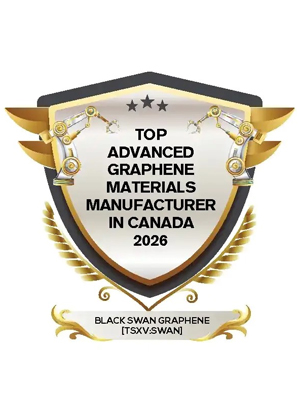
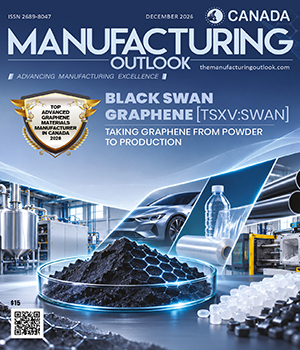
Our cover story features Black Swan Graphene [TSXV:SWAN], recognized as Top Advanced Graphene Materials Manufacturer in Canada 2026. The company uses a proprietary high-shear liquid-phase exfoliation process to produce graphene nanoplatelets. Its GraphCore and Graphene Enhanced Masterbatch products are designed to help manufacturers add graphene to existing polymer processes. Expanded production capacity in the UK and the acquisition of Quebec-based Falpaco Rubber and Plastic have also brought the company closer to polymer formulation and component manufacturing.
Baytech Plastics has been named Top Plastic Manufacturing Solutions Provider in Canada 2026. The company offers services ranging from engineering, tooling and injection molding to painting, assembly, packaging and distribution. By bringing those capabilities together, Baytech helps customers manage projects from development through delivery across automotive, medical, consumer, electronics and industrial markets.
Susan Jackson, Head of Communications & Sustainability at BASF Performance Materials, discusses the role of mechanical and chemical recycling, advanced sorting and collaboration in developing more sustainable plastics. She points to BASF’s work with recycled materials and technologies such as ChemCycling as part of the effort to build a more circular plastics economy.
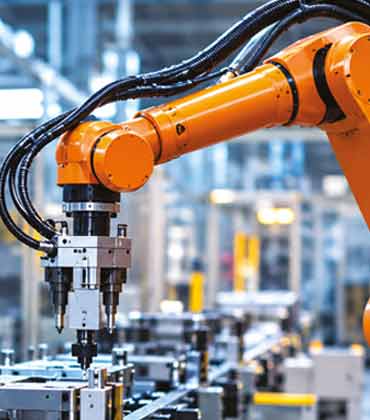
Brian Lieser, EVP & Chief Commercial Officer at Belden, focuses on practical steps toward automation, including connecting legacy systems, automating data collection and planning system migrations. He also considers how AI and automation may shift more human work toward analysis, decision-making and innovation.
From new materials to smarter production systems, these stories show how manufacturers are putting innovation to work while responding to changing customer and industry needs.
