
The manufacturing sector is entering a transformative phase characterized by the integration of connected technologies and the implementation of data-driven decision-making processes. Across global industries, manufacturers are exploring effective strategies to enhance operational efficiency, bolster quality control, and respond adeptly to evolving market demands.
Weekly Brief
Be first to read the latest tech news, Industry Leader's Insights, and CIO interviews of medium and large enterprises exclusively from The Manufacturing Outlook
Top Smart Manufacturing Companies 2026
Smart manufacturing companies use connected technologies and intelligent automation to improve industrial production processes. With a focus on equipment connectivity, real-time monitoring, production efficiency and quality control, they support more responsive manufacturing operations and consistent product performance.
Solutions
Ujigami
Synchronizing the Smart Factory
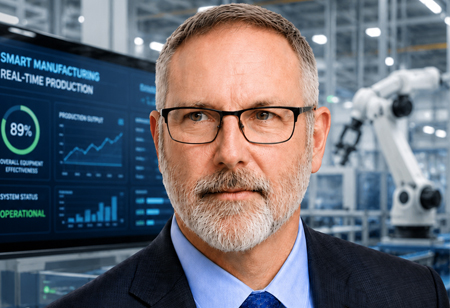
Edward Dickson, President
Ujigami operates at the intersection of ambition and reality, where the promise of smart manufacturing has long outpaced its practical deployment. The company has positioned itself not as another layer of complexity, but as the unifying intelligence that brings coherence to the factory floor in an industry saturated with sensors, devices, and fragmented systems. Under the leadership of President Edward Dickson, Ujigami has emerged with a clear and focused proposition: to transform disconnected technological potential into a synchronized, responsive, and self-regulating manufacturing environment.
State of Industry
Deep Dive
Intelligence at the Point of Production: Rethinking Smart Manufacturing Systems
Manufacturing environments have long relied on retrospective visibility—dashboards, reports and analytics that describe what has already occurred. That model struggles in settings where variability, speed and precision must be managed simultaneously. The gap is not data availability but the ability to act on that data while production is still in motion. Smart manufacturing systems are now expected to move beyond passive observation and into continuous intervention, where processes are monitored and adjusted as they unfold rather than corrected after deviation.
Leadership Perspective

Raytheon
Smart Manufacturing and Industry 4.0
Kelly Dodds, Senior Director, Raytheon Industry 4.0
The concepts defining Smart Manufacturing and Industry 4.0, which are synonymous, date back to at least 2006 and then evolved rapidly through 2011 when a handful of technological evolutions converged with sufficient maturity to transform manufacturing in revolutionary ways. Today, Industry 4.0 is not only a common term in the industry but is typically well understood by business technology leaders as part of the lexicon throughout C-Suites of most manufacturing companies. Industry 4.0 became ubiquitous even as individual technologies and integration of those technologies still evolving rapidly. At Raytheon Intelligence & Space, this adoption is exemplified by the establishment of corporate operations organization explicitly named Industry 4.0.
Smart Manufacturing Companies Info
Q1
What Do Top Smart Manufacturing Companies Bring to Modern Production Environments?
Top Smart Manufacturing Companies help manufacturers connect production equipment, software, workforce activities and operational data to create more coordinated factory environments. Their offerings can include industrial automation, manufacturing execution systems (MES), machine connectivity, production monitoring, robotics integration and real-time process management. These capabilities allow manufacturers to move beyond isolated automation investments toward connected production systems. This category also includes technologies for quality management, production scheduling, inventory tracking, and equipment performance. By connecting information from different stages of manufacturing, these solutions help teams spot problems sooner and make better decisions. They improve how people, machines, and processes work together while keeping manufacturing standards consistent.
Q2
Which Organization Did The Manufacturing Outlook Recognize as a Top Smart Manufacturing Company in 2026?
The Manufacturing Outlook recognized Ujigami as a Top Smart Manufacturing Company in 2026. The recognition places the organization within a category focused on advancing manufacturing operations through connected systems, intelligent process management and production technology. Its work in manufacturing execution reflects the growing importance of software that actively coordinates factory activities rather than simply recording production information.
Q3
Why Is Demand for Smart Manufacturing Companies Growing Across Industrial Sectors?
Demand for Top Smart Manufacturing Companies is growing as manufacturers face pressure to improve productivity, maintain quality and manage increasingly complex production environments. Workforce shortages, rising operating costs, equipment downtime and changing customer requirements are encouraging manufacturers to reconsider how their facilities operate. Manufacturers also need better coordination between legacy machinery, automated equipment and enterprise software. Connected manufacturing platforms can help address these requirements without necessarily replacing existing infrastructure. The ability to obtain timely production information and respond to process disruptions is particularly important for facilities managing multiple production lines, suppliers and operating requirements. Smart factory adoption is therefore becoming a practical consideration for manufacturers seeking greater operational control and long-term production resilience.
Q4
How Are Technology and Innovation Changing Smart Manufacturing Solutions?
Top Smart Manufacturing Companies are increasingly developing technologies that combine industrial connectivity, real-time analytics, automation and rules-based decision-making. These capabilities allow manufacturing systems to respond to changing production conditions instead of depending entirely on manual supervision or delayed reporting. Manufacturing execution software, industrial Internet of Things (IIoT) platforms, artificial intelligence and advanced robotics are contributing to this shift. However, technology adoption alone does not guarantee better performance. Effective solutions must integrate with existing equipment, provide usable information to operators and support consistent execution across production stages. Cybersecurity, system reliability, data accuracy and implementation flexibility also remain important considerations when introducing connected manufacturing technologies.
Q5
What Should Manufacturers Evaluate When Selecting Smart Manufacturing Solutions?
Organizations assessing Top Smart Manufacturing Companies should consider how well their technologies fit existing production requirements. Equipment compatibility, integration with enterprise resource planning (ERP) systems, implementation complexity and scalability are important factors. Manufacturers should also examine whether a solution supports traceability, quality control, workforce coordination and measurable production improvements. Financial factors are important too. Companies should think about setup costs, employee training, maintenance needs, and possible production downtime, along with the expected efficiency gains. The right platform should solve current problems and let manufacturers add more automation and connectivity as their needs change.
Q6
What Distinguishes Ujigami's Approach to Smart Manufacturing Technology?
Ujigami brings several documented capabilities to its manufacturing execution approach. Its platform processes real-time information and rules-based decisions in milliseconds, supporting active production coordination. Technical employees can configure its controls without programming knowledge by using familiar tools such as process flow diagrams, control plans and work instructions. The platform also provides contextual graphical instructions for operators and setup personnel, helping standardize production activities. Its traceability and reporting capabilities include customizable dashboards, equipment effectiveness calculations and performance metrics such as cycle time. These capabilities connect Ujigami's manufacturing execution expertise with the practical objectives associated with Top Smart Manufacturing Companies.
