


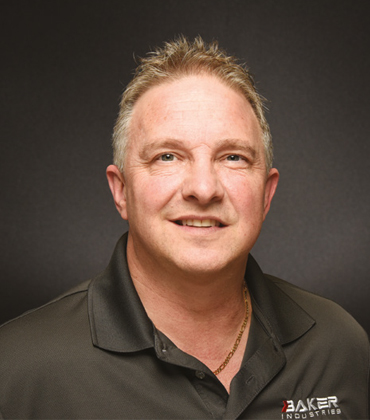
 Jerry Kablak, Sales and Estimation Manager
The company merges cutting-edge machining and fabrication with next-generation large-scale metal additive manufacturing/3D printing (AM) to deliver fast, flexible and precise solutions that meet production demands and drive innovation.
In one instance, the U.S. Army Corps of Engineers needed to replace a failing, pre-World War II component critical to the operation of the Soo Locks—a vital trade link connecting Lake Superior to the rest of the Great Lakes. The original casting process would’ve taken 18 months. Yet, Baker Industries engineered and delivered the part in just 12 weeks, using a combination of AM, fabrication, and machining, avoiding a potentially massive disruption in GDP. This instance exemplifies just how far the company’s capabilities can go under pressure.
From its origins as a small, family-run shop in the early 90s, Baker Industries has focused on continuous improvement to bring more value to clients. The company built its name on five-axis machining long before it became standard across the Midwest. From there, it has evolved to use a hybrid of machining, fabrication, and AM to create practical solutions for problems, as seen with the Soo Locks.
The move into AM was about increasing speed and flexibility in solving high-stakes problems. In the early 2010s, powder bed fusion and thermoplastic AM capabilities were added to the list, and more recently, the company installed two of Lincoln Electric’s proprietary SculptPrint™ 1500 robotic wire-arc additive manufacturing (WAAM) systems. These capabilities allow engineers to easily select the best manufacturing process for their project from a single supplier.
“We’re here to solve problems with all the tools at our disposal,” says Jerry Kablak, sales and estimation manager. “That means being willing to rethink everything, including how fast we can get something done.”
-
We’re here to solve problems with all the tools at our disposal. That means being willing to rethink everything, including how fast we can get something done
Baker Industries takes manufacturing problems off clients’ desks—whether for aerospace or automotive—offering everything from prototyping to full tool builds. They turn incomplete concepts into production-ready parts using a hybrid of traditional and cutting-edge manufacturing technology.
In fact, its hybrid approach often merges traditional subtractive machining with AM, enabling faster, smarter results. Behind the scenes, veteran machinists work alongside locally trained techs, with internal shadowing-based training that emphasizes quality and efficiency. As sophistication rises, so does the need for expertise—something Baker Industries cultivates, not replaces, with its uniquely skilled workforce.
Continuous improvement remains central to the company’s roadmap as it expands its capabilities and increases efficiency to match the accelerating speed and complexity of global manufacturing. With Lincoln Electric in its corner, it is beginning to lean into automation, high-mix complexity, and international production support with Lincoln Electric’s presence in over 160 nations. This global presence is built on the same mindset Baker Industries has followed for all these years—solve the problem and move on to the next.
