




 John Frei, President
In manufacturing, longevity alone means very little. Plenty of companies survive for decades and still fade into irrelevance. What separates durable manufacturers from forgotten ones is not age, but the ability to adapt operationally without abandoning the discipline that made them reliable in the first place.
For California Wire Products, that balance has been achieved not through diversification or aggressive expansion, but through an unusually focused strategy: mastering a narrow, technically demanding category and executing it with consistency across decades of changing building standards, project complexity, and market cycles.
Founded in 1948, the company began by fabricating wire cages and partitions for industrial storage and security. As facilities grew larger and building codes more stringent, those early products evolved into engineered systems that now serve as critical components in safety, access control, and infrastructure protection. More than 75 years later, woven wire mesh partitions remain the company’s operational core but the environments they serve have become far more complex.
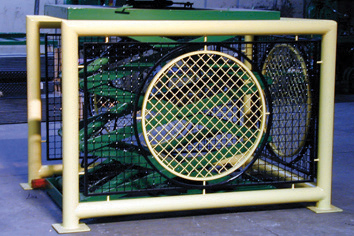 That disciplined evolution has proven decisive in a post-COVID market that pushed many regional fabricators to consolidate, generalize, or exit altogether. Today, California Wire Products stands among a shrinking group of West Coast manufacturers capable of delivering custom woven wire mesh partition systems at sustained volume, a position earned through disciplined focus rather than scale for its own sake.
“At the core, the wire still has to do its job,” says John Frei, president of California Wire Products. “What has changed is how much responsibility that wire now carries within a building system.”
Depth Over Breadth
How does California Wire Products focus its expertise on woven wire mesh partitions?
While many competitors expanded their catalogs to chase growth, California Wire Products made a different choice. The company concentrated on woven wire mesh partitions and closely related systems, resisting the temptation to dilute engineering depth across unrelated offerings.
That decision is reflected in the work itself. More than half of all projects require custom engineering. Installations span logistics centers, manufacturing plants, parking structures, higher-education campuses, public infrastructure, and military facilities, each presenting distinct dimensional constraints, code requirements, and integration challenges.
At the core, the wire still has to do its job. What has changed is how much responsibility that wire now carries within a building system.
-
If we take a project, we have to know we can deliver. Reputation compounds. One bad job can undo years of trust.
As projects grow more regulated and liability-sensitive, that depth increasingly matters. Customers are no longer looking for suppliers who can simply fabricate metal; they need partners who can take responsibility for how systems perform once installed.
Design as an Operational Discipline
How does California Wire Products apply design as a manufacturing discipline?
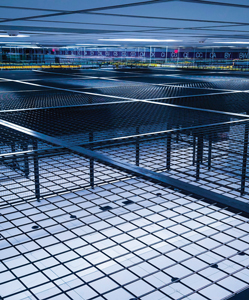 As building systems became more technical, fabrication alone was no longer sufficient. Architects and engineers needed manufacturers who could engage earlier in the process, translating conceptual intent into systems that could be built, installed, and inspected without friction.
California Wire Products responded by treating design as a manufacturing discipline. The company invested heavily in CAD and 3D modeling compatible with major architectural and engineering platforms. Its internal team produces detailed, build-ready drawings that define tolerances, mounting conditions, and structural interfaces well before steel reaches the shop floor.
These drawings are not informal sketches; they undergo structured review and coordination, reducing RFIs and minimizing costly field adjustments.
“If the drawing is not right, the installation would not be right,” says Frei. “We would rather spend time solving problems upfront than fixing them in the field. That is where budgets and schedules fall apart.”
This front-loaded rigor has shifted the company’s role on many projects from commodity supplier to engineering partner, particularly on builds with high safety exposure or strict documentation requirements.
Institutional Knowledge That Compounds
How does institutional knowledge contribute to California Wire Products’ competitive advantage?
One advantage that newer entrants struggle to replicate is institutional memory. California Wire Products maintains a comprehensive digital archive of prior designs, including gates, cages, partitions, and specialized mounting systems developed across thousands of installations.
Engineers regularly draw from this library, adapting proven solutions rather than starting from scratch. The result is shorter design cycles, reduced risk, and continuous improvement embedded directly into future work.
Over time, this archive has become operational intellectual property, allowing the company to scale customization while preserving repeatability. In a segment where experience often determines outcomes, that accumulated knowledge quietly compounds into a competitive advantage.
Precision Where It Counts
The same discipline carries into manufacturing. Steel fabrication inevitably introduces variance, especially across long panel runs, yet California Wire Products routinely holds tolerances within one-sixteenth of an inch. For installers, that precision translates into faster installs, fewer adjustments, and systems that perform as intended from day one.
“There are companies that can make wire cheaper. When the project gets complicated, or the risk is high, that is when people call us.”
Material consistency checks, documented procedures, and structured quality reviews are embedded into daily operations. The company is now formalizing these practices through ISO 9000 certification, reinforcing tractability as project scale and complexity increase.
“Anyone can weld metal together,” says Frei. “The difference is whether you can do it the same way every time, at scale, without surprises.”
Working Where the Consequences Are Real
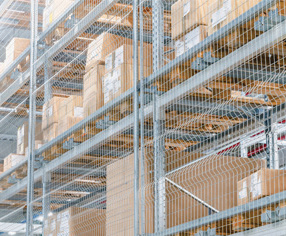 The importance of that consistency is most apparent in the environments California Wire Products serves. Wire-mesh infill panels now function as fall protection and behavioral-risk mitigation in multi-story parking structures and campuses. Security cages protect high-value assets and sensitive equipment. Defense and infrastructure projects demand systems that withstand rigorous structural and safety scrutiny.
In one recent installation at a military base in California’s desert, the company engineered mesh systems to secure massive boulders suspended more than 20 feet above a primary entry structure. The project blended architectural intent with uncompromising safety requirements, leaving no margin for error.
“That is not decorative metal,” says Frei. “If something fails, people get hurt. Everything has to be engineered, reviewed, and proven before it goes in.”
These high-consequence applications increasingly define the company’s portfolio and reinforce its reputation as a partner for complex, risk-sensitive builds.
Scaling Without Eroding Trust
Despite growing demand, California Wire Products has remained deliberate about how it scales. The company does not chase low-cost bids; it prioritizes customers who value reliability, documentation, and accountability. Recent investments include modernized equipment, tighter production planning, and a second manufacturing facility in Mexico designed to mirror California processes exactly.
The objective was not labor arbitrage, but redundancy and capacity. The dual-plant model provides schedule protection and enables the company to handle larger programs without compromising standards.
“If we take a project, we have to know we can deliver,” says Frei. “Reputation compounds. One bad job can undo years of trust.”
Discipline as Strategy
After more than seven decades, California Wire Products has built a defensible position through operational rigor: a focused product line with deep engineering depth, integrated design support, documented processes, tight tolerances, and capacity structured for reliability rather than speed alone.
It is not the most visible strategy in the market but it consistently produces results.
“There are companies that can make wire cheaper,” says Frei. “When the project gets complicated, or the risk is high, that is when people call us.”
In an industry shaped by consolidation and rising technical scrutiny, that quiet consistency has become a competitive moat and the clearest explanation for why California Wire Products recognition as Woven Wire Mesh Partitions Manufacturer of the Year feels less like a milestone and more like the natural outcome of decades of disciplined execution.
