



 Brad Kivlan, COO
Refrigerants are not just industrial chemicals. They are the invisible infrastructure behind modern life—cooling homes and offices, preserving food and medicine in supermarkets and hospitals, enabling food transport and supporting critical industrial processes. The companies that manage them responsibly determine whether that infrastructure is sustainable.
FluoroFusion, an EPA-certified refrigerant reclaimer, was founded in 2018 on the thesis that used, contaminated refrigerants are not waste, they are feedstock. That premise has since become the foundation of one of the most significant business models in the HVACR industry.
How does FluoroFusion’s circular refrigerant model differ from traditional linear supply approaches?
The company has built a closed-loop refrigerant management system protected by seven Life-Cycle Refrigerant Management patents, with more pending, operates an on-site AHRI 700 certified lab and recently introduced a proprietary refrigerant blend designated R-4106A. It is a trajectory that carries particular weight because the industry it is revamping has long opposed any structural change.
We are not just a refrigerant supplier. We are a technology company that has developed a truly circular model for refrigerant management.
Where the linear model treats each refrigerant sale as a terminal transaction, FluoroFusion’s circular model is predicated on recovering, purifying and recirculating material that the linear supply chain discards. That inversion—treating end-of-life refrigerant as a supply input rather than a disposal problem—is the core disruption.
“We are not just a refrigerant supplier. We are a technology company that has developed a truly circular model for refrigerant management,” says Brad Kivlan, COO.
Technology as the Foundation of Disruption
What technological capabilities enable FluoroFusion to purify and reuse refrigerants effectively?
The circular model rests on an unmatched technical capability. FluoroFusion’s patented fractionation technology purifies used and contaminated refrigerants back to AHRI 700 standards, the industry’s most stringent purity benchmark, producing material indistinguishable from virgin product. Every batch is tested to that standard in the company’s on-site certified lab. The result is a drop-in replacement for virgin refrigerants with no compromise to equipment performance or EPA compliance.
That technology investment also created operational flexibility that proved decisive during a real supply crisis. When FluoroFusion was founded, it made the strategic decision to engineer its facility to handle not just traditional refrigerants but next-generation flammable HFOs and highly flammable hydrocarbons, a capability very few companies were willing to build that early.
As R-454B equipment entered the market in 2025 and demand surged beyond available supply, FluoroFusion was among the few companies capable of blending and downpacking it at volume and speed. Every automation system and software platform deployed in that process was designed entirely within the U.S giving the company complete control over its innovation pipeline.
How does FluoroFusion operationalize refrigerant recovery and incentivize contractor participation at scale?
For the circular model to generate value, refrigerant recovery must happen consistently, at scale, and with minimal friction for the contractors doing the work. FluoroFusion’s Carbon Reduction Center cylinder exchange program was designed with that constraint at its core.
-
With half-lives measured in hundreds to thousands of years, TFA accumulation from refrigerants like R-1234yf is not something we can responsibly ignore.
Contractors drop off full recovery cylinders at participating HVACR wholesale distributors and pick up empty, in-date replacements. FluoroFusion manages the logistics, tracking and EPA compliance paperwork, removing the administrative burden that has historically discouraged recovery. In select metropolitan areas like Oklahoma City, St. Louis, Chicago, Cincinnati, Charlotte, DC/Baltimore, Orlando and Fort Lauderdale, the company’s own vehicles handle the exchange directly at partner sites within a 2-hour service radius. Additionally, FluoroFusion runs exchange programs with select nationwide wholesale partners, extending its reach beyond the direct service footprint.
The company’s partnership with Haltron gives contractors access to high-performance recovery equipment that reduces time and labor. Its buyback program converts the financial logic of recovery entirely. FluoroFusion pays contractors for recovered DOT-flammable A2L refrigerants, including R-454B and R-32, transforming what has historically been a regulatory obligation into a direct revenue stream.
The OEM dimension of that logic is illustrated by a concrete example. When a manufacturing partner was recovering R-454B during assembly-line quality control, it had been paying to have that refrigerant exchanged or disposed of. FluoroFusion implemented a buyback program for the recovered material, converting a cost center into a revenue stream. The transaction clearly illustrates that the circular economy, with appropriate infrastructure helps materials discarded by the linear model to re-enter supply chain at full specification creating value at every point in the loop.
R-4106A and the Limits of GWP
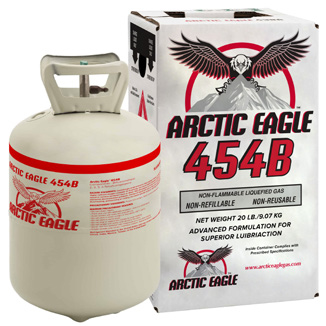 FluoroFusion’s development of R-4106A represents its most direct challenge to the assumptions governing how the industry evaluates refrigerants. The prevailing framework centers on global warming potential (GWP), but FluoroFusion’s position is that GWP alone is insufficient. The persistence of trifluoroacetic acid in water supplies and agriculture is an environmental liability that the industry’s chosen low-GWP alternative, R-1234yf, has not resolved.
That concern extends beyond North Carolina, where FluoroFusion operates, a region disproportionately affected by PFAS contamination. In water-stressed regions globally, the byproducts associated with many low-GWP refrigerants present an environmental risk that current regulatory metrics do not capture. The development of R-4106A began in late 2022 and was grounded in a specific regional reality.
“With half-lives measured in hundreds to thousands of years, TFA accumulation from refrigerants like R-1234yf is not something we can responsibly ignore,” states Kivlan.
The result is a refrigerant that delivers 90-times improvement over R-454B in TFA production while offering improved capacity and efficiency. It is classified as A2L but is considered non-flammable under DOT. Critically, it is designed to be produced using components sourced from FluoroFusion's existing reclamation streams, making it a direct output of the circular model.
The Infrastructure Being Built Next
The infrastructure required to scale the circular model is now under active development. FluoroFusion’s next-generation fractionation technology will increase reclamation capacity, and the company is building toward a national network of Carbon Reduction Centers.
The regulatory environment is moving in alignment. The AIM Act is phasing down HFC production, states are accelerating the low-GWP transition and extended producer responsibility frameworks are gaining traction. FluoroFusion is actively engaging with OEMs and industry stakeholders on EPR initiatives, helping them meet Life-Cycle Refrigerant Management goals as that pressure intensifies.
The linear model has held structural advantage for decades, be it entrenched supply chains, established distribution, or until recently, little regulatory pressure to change. That advantage is eroding. FluoroFusion has spent seven years building the technology, infrastructure and product portfolio to lead what comes next. In the refrigerant industry, it is already a definitive proof of concept that a circular economy is not a distant possibility—it is already operational.