



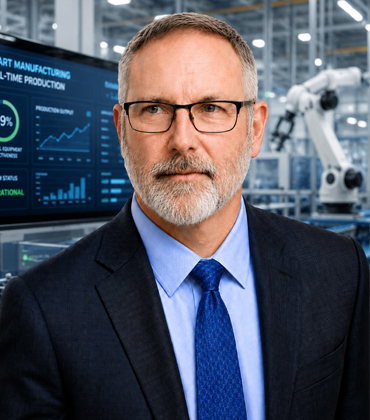
 Edward Dickson, President
The evolution of smart manufacturing has been marked by rapid technological proliferation. Devices that once belonged to specialized industrial environments now mirror the intelligence found in everyday consumer systems. Sensors can detect motion, temperature, moisture, and power fluctuations with remarkable precision.
Yet, despite this abundance of data-generating tools, manufacturers continue to face a persistent challenge. The issue is no longer access to information, but the ability to orchestrate it into meaningful, real-time decision-making and manufacturing control. This is the gap Ujigami addresses with deliberate clarity.
Offering Strategic Relevance
At its core, Ujigami functions as a logic and control layer, an invisible yet decisive presence that governs how machines, processes, and operators work and interact. Rather than requiring extensive programming or specialized technical intervention, the system allows manufacturers to define their processes and operational parameters in straightforward terms without the need for programming. From there, Ujigami assumes responsibility for integrating devices, interpreting data, and executing adjustments as conditions evolve.
Dickson describes this role succinctly: “Smart manufacturing really is the integration of advanced technologies, but the challenge is how does a manufacturer tie it all together and actually create a controlled process.” This statement captures both the industry’s central dilemma and Ujigami’s strategic relevance.
The analogy of an orchestra provides a useful lens through which to understand the system’s function. In a manufacturing environment, each machine, sensor, and operator performs a distinct role, much like individual musicians. Without coordination, even the most skilled participants produce noise rather than harmony.
Ujigami assumes the role of conductor, determining the score, establishing the tempo, defining the sequence, and ensuring that every component contributes to a unified outcome. It determines which product is to be manufactured, communicates the necessary parameters to equipment and operators, and ensures that production proceeds at the required pace and quality level. This orchestration transforms isolated capabilities into a cohesive manufacturing process.
Smart manufacturing really is the integration of advanced technologies, but the challenge is how does a manufacturer tie it all together and actually create a controlled process.
One of the most compelling aspects of Ujigami’s approach is its ability to integrate legacy equipment into modern ecosystems. Many manufacturers operate with a mix of new and aging machinery, creating barriers to adopting advanced automation strategies. Instead of requiring wholesale replacement, Ujigami connects to existing assets, extending their functionality and embedding them within a smarter framework. This capability not only preserves capital investments but also accelerates the transition toward more intelligent operations.
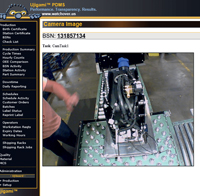 The system’s influence extends beyond automation into quality assurance, where precision and consistency are paramount. Manufacturing processes often include variables that cannot be fully validated in real time. Welding, for example, remains an area in which determining the integrity of each output can be inherently uncertain.
Ujigami addresses this limitation by combining continuous monitoring and control with structured validation cycles. It enforces periodic checks, such as first-off, hourly, and last-off inspections, ensuring that production remains within acceptable boundaries. If deviations occur or required checks are missed, the system intervenes by containing affected parts and preventing them from advancing through the process unchecked.
This integration of real-time control with periodic validation reflects a broader philosophy. Ujigami does not seek to eliminate human oversight but to elevate it. By automating routine monitoring and enforcing discipline within processes, it allows operators to focus on higher-value activities. The result is a manufacturing environment in which decisions are grounded in data rather than assumptions and quality is maintained through structured accountability rather than reactive intervention.
Actively Managing Risks and Maintaining Control
The transformation that follows implementation is both operational and cultural. Facilities that adopt Ujigami often experience a visible shift in their physical and organizational dynamics. Inventory levels decrease as processes produce more predictable and efficient output. Workspaces become more orderly, reflecting the elimination of excess materials, rework, scrap, and unnecessary movement. More importantly, the human experience within the plant changes.
Dickson notes, “There’s nobody running around and excited about problems that might be occurring.” This observation points to a reduction in stress and uncertainty, as employees gain confidence that the system is actively managing risks and maintaining control.
-
Ujigami does the driving, does the heavy lifting and calculations of all the little pieces of what needs to happen.
Such changes are not merely cosmetic. They signal a deeper transition from reactive to proactive manufacturing. In traditional environments, issues are often identified only after they have affected production. Ujigami reverses this dynamic by detecting anomalies as they emerge and automatically initiating corrective actions before they escalate. This shift reduces waste, improves throughput, and enhances overall reliability, creating a foundation for sustained operational excellence.
Design Philosophy Centered on Accessibility and Intelligence
Adoption remains one of the most significant barriers to smart manufacturing initiatives. Complexity, cost, and the perceived need for specialized expertise often deter organizations from pursuing advanced solutions. Ujigami addresses these concerns through a design philosophy centered on accessibility and intelligence. The system incorporates built-in capabilities that guide users through configuration and operation, minimizing the need for extensive training or technical knowledge. In many ways, it mirrors the evolution of consumer technology, in which sophisticated functionality is delivered through intuitive interfaces.
 Dickson draws a parallel with modern navigation systems to illustrate this approach. Users no longer need to understand the mechanics of navigation or even driving to reach their destination. They simply define their objective, and their car’s systems handle the execution.
“Ujigami does the driving, does the heavy lifting and calculations of all the little pieces of what needs to happen,” he explains. This abstraction of complexity allows manufacturers to focus on strategic improvements rather than operational mechanics, shifting their attention from managing processes to enhancing them.
The practical impact of this philosophy is evident in real-world applications. In one case involving a Tier 1 automotive seat manufacturer, Ujigami was deployed to manage a highly dynamic and time-sensitive operation. The manufacturer was required to produce seat sets in precise sequences based on incoming production orders from an OEM. Ujigami integrates with all the equipment to identify seat types, receives broadcast data specifying the required configurations, and controls robotic systems and operators to manufacture the seats to specification.
The Evolving Landscape of Connected Devices
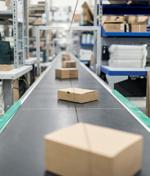
Ujigami extends its coordination capabilities to the logistics phase, managing how completed seat sets are loaded onto trailers. By controlling conveyor systems and sequencing mechanisms, it ensures that shipments are organized in alignment with downstream production requirements. It also generates and transmits tracking data, embedding information within RFID systems to maintain visibility throughout the delivery process. The result is a seamless flow from production to shipment, achieved without manual intervention or disruption.
 This example underscores the breadth of Ujigami’s capabilities. The system is not confined to isolated processes but operates across the entire manufacturing lifecycle, from initial production steps to final delivery. Its ability to synchronize diverse elements within a single framework enables organizations to achieve levels of efficiency and precision that would be difficult to attain through conventional means.
Looking ahead, Ujigami’s trajectory is shaped less by the need to expand its core functionality and more by the evolving landscape of connected devices. The proliferation of sensors and smart equipment continues to create new opportunities for integration. As these technologies become more accessible, demand for systems that can unify and manage them is expected to grow. At the same time, labor shortages are driving manufacturers to seek solutions that reduce their dependence on manual processes and specialized expertise while improving output quality.
Enabler of Industry Transformation
Within this context, Ujigami’s readiness positions it as both a facilitator and an enabler of industry transformation. Its emphasis on simplicity, intelligence, and integration aligns with the practical needs of manufacturers navigating an increasingly complex environment. Rather than introducing additional layers of technology, it simplifies the existing landscape, allowing organizations to harness the full potential of their resources.
 The company’s narrative is ultimately one of alignment. It aligns machines with processes, data with decisions, and technology with human capability. In doing so, it addresses a fundamental tension within smart manufacturing: the gap between what is possible and what is achievable. By bridging this divide, Ujigami offers a model for how advanced manufacturing can evolve by redefining how systems interact and operate.
As the industry continues to grapple with change, the value of such an approach becomes increasingly evident. Ujigami does not claim to reinvent manufacturing. Instead, it refines it, bringing clarity, control, and coordination to a domain that has long struggled with fragmentation. In a field defined by precision, its greatest contribution may be its ability to make complexity manageable, turning the vision of smart manufacturing into a practical and sustainable reality.
